

 Dec 30, 2025 - Luke Whitburn
Whether you work out to build muscle, lose weight, supplement a sports program or simply improve your health, chances are you’ve come across a smith machine before. The premise of them is simple enough: a straight bar that you can load with weight that travels up and down a pair of uprights. But while there are certainly parallels between a smith machine and the more typical setup of a barbell in a power rack, there are some key differences that make them a favourite in home and commercial gyms alike.
What’s the difference between a smith machine and a traditional barbell?
The two key differences that exist between a smith machine and a traditional barbell are stability and plane of motion.
Because the smith machine bar can only move up and down, it provides quite a different training experience to the conventional barbell, which can travel up, down, left, right and every direction in between.
As such, you’ll experience more stability when training on a smith machine. Your muscles don’t need to work as hard on keeping the barbell balanced as you work, which some people find allows them to hone in on the muscle group that they’re targeting more effectively than they can with a barbell.
Smith machines also operate in a fixed plane of motion. Again, this all comes from how the bar can only move up and down. There’s a whole laundry list of pros and cons between training in a fixed plane of motion and working in a free path (like a traditional barbell), but to keep things brief we’d say the key takeaway is that a fixed plane of motion can be safer when working on rehabbing injuries, while a free path is more effective at building stabilisation and functional strength.
Why train on a smith machine?
There are plenty of reasons that people opt for the smith machine in their training programs. The added stability takes pressure off your stabiliser muscles, which is especially important for anybody coming back from an injury or who needs to be careful with how much load they put on their joints.
More than that, smith machines are a very popular option for training at home, which is why you’ll see so many all-in-one home systems coming with smith machines. This is because the bar can be latched onto the uprights at nearly any point on the rack, which makes it easier to abandon failed reps in heavy pressing movements like a bench press. This negates the need for a spotter or safety arms and enables users to push until complete failure.
The lower body benefits, too. That fixed plane of motion we talked about makes the smith machine a really smart way to train calves, bulgarian split squats and other lower body exercises which allow you to load the bar heavy without needing to worry about stabilising the movement.
The smith machine isn’t a response to the barbell, but rather its own piece of training equipment that has its own use cases and benefits.
What exercises can I do on a smith machine?
There are endless training options that you can perform with a smith machine. To help you hit the ground running, MuscleSquad’s home gym guru and qualified PT Carl listed some of his favourites in this video. Keep scrolling to see the list in text if you’d prefer.
Chest & Triceps
High Incline Bench Press
Incline Bench Press
Low Incline Bench Press
Flat Bench Press
JM Press (Close Grip Tricep)
Shoulders & Back
Seated Shoulder Press
Rear Delt Row
Traditional Barbell Shrug
Single Arm Shrug
Traditional Upright Row
Single Arm Upright Row
Back & Biceps
Inverted Row
Bent Over Row
Barbell Drag Curls
Legs & Glutes
Lunge / Split Squat
Narrow Stance Squat (Quad Focus)
Wide Stance Squat (Glute & Adductor Focus)
Romanian Deadlift (RDL)
Bulgarian Split Squat
Calf Raises
Hip Thrusts
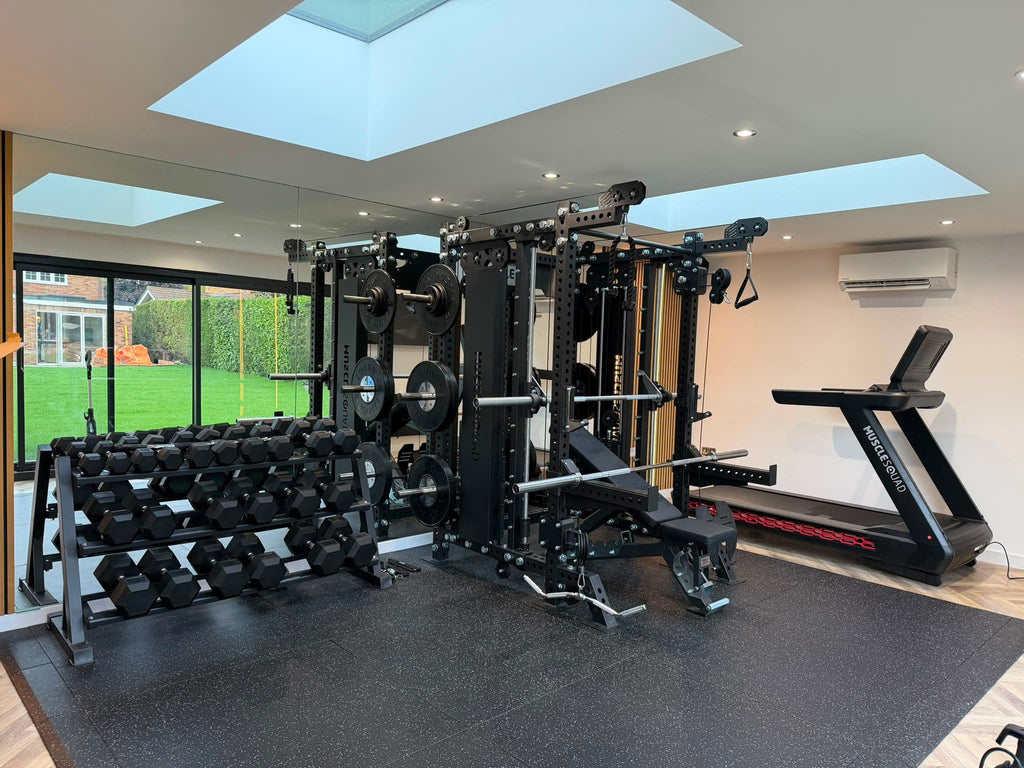
Ready to see what purchasing options are out there? Here are some of our best-selling racks that come equipped with a smith machine.

Leave a comment: