

 Feb 04, 2026 - Cameron Brierley
It’s reasonable to think that the only way to improve your running is to, well, run, but this couldn’t be further from the truth. Running should form the backbone of your training program, but it’s by no means your only option. Professional athletes from all disciplines supplement their sport with strength training, and running is no different.
We’ve listed five essential strength training exercises that any experienced runner should be doing to improve performance. These aren’t essential for beginners; it’s far more important to develop a regular running schedule first, but if you’ve already reached that point then this guide is absolutely for you.
Do bear in mind that we’ve chosen these exercises with long-distance running in mind. There’s some overlap with the movements we’d recommend a sprinter to do, but the focus here is to build muscular endurance and mobility, rather than explosive power like you might find in a sprinting guide.
With that said, let’s get to it.
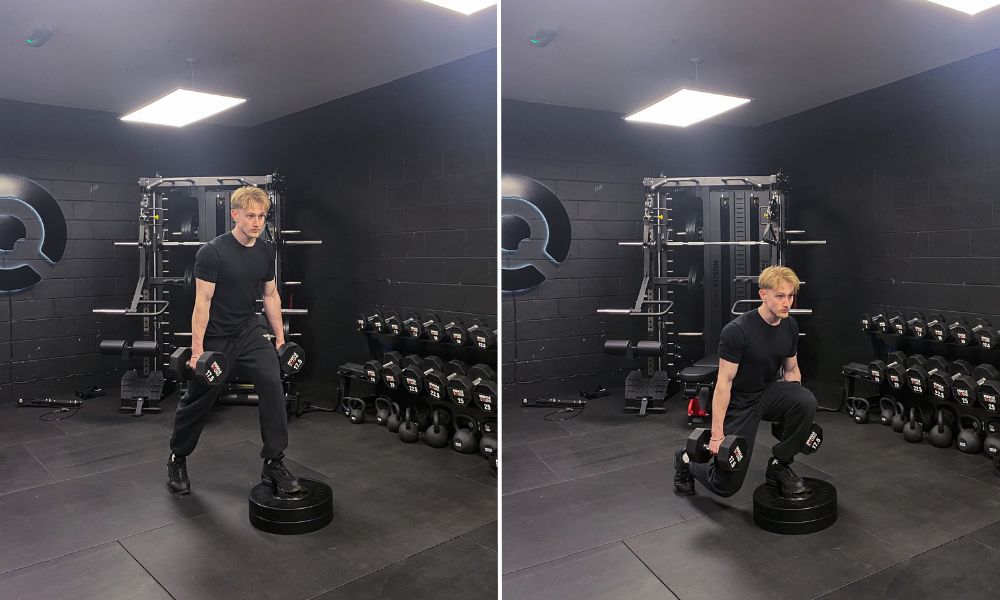
Exercise #1: Front foot elevated split squat
Equipment needed: Dumbbells and a raised platform (bench, stool or weight plates)
Volume: 3 sets of 12-15 reps
Primary muscle(s): Quads, glutes

Form: Set up a raised surface in front of you using either a few weight plates, a small bench or even a household stool. Place your lead foot on top of the surface and extend your other foot out behind you. Bring your rear leg down so that your knee forms a right angle and is almost touching the floor, and then push yourself back up to the starting position. Once you’ve completed a set with one leg raised, repeat it on the other leg.
This exercise is all about building endurance in the quads along with enhancing hip mobility, which is essential for long-distance runners. Work in the 12-15 rep range as you build up that unilateral strength under load, which is ideal for tackling any muscular imbalances.
Exercise #2: Dumbbell RDLs
Equipment needed: Dumbbells
Volume: 2 sets of 10 reps
Primary muscle(s): Hamstrings, glutes

Form: Stand in a neutral stance with a pair of dumbbells in each hand. While keeping your back straight, push your rear out behind you as you keep the dumbbells close to your legs. Focus on keeping your knees soft. Not locked out, but certainly not bent. Following this movement path ensures your hamstrings are being properly stretched and targeted. Once you’ve gone as low as you can and feel a good stretch in the back of your legs, reverse the movement to return to the starting position.
Romanian deadlifts, commonly called RDLs, are an excellent movement to target your hamstrings. In endurance running, it’s often the hamstrings that cause athletes problems. If they tighten and cramp up, you run the risk of hurting or even tearing the muscle in extreme cases. With that in mind, putting some hamstring work in during your gym sessions is well worth the time. Remember what we said in the form guide about keeping your knees soft, but not locked, and you'll really feel the benefits of this one.
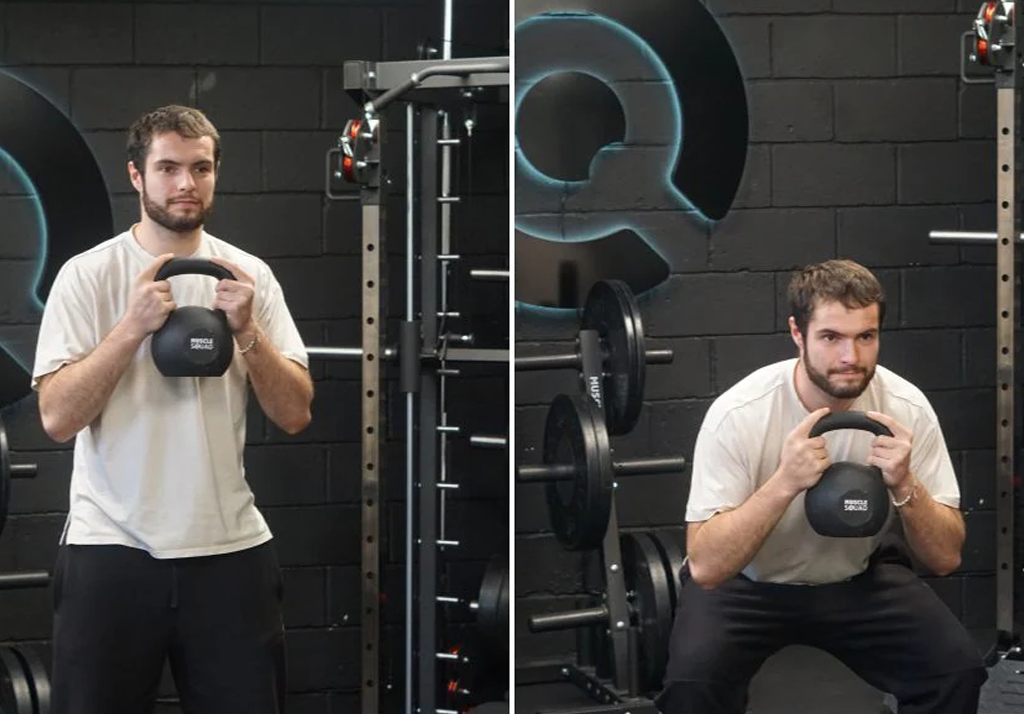
Exercise #3: Goblet squats
Equipment needed: Kettlebells
Volume: 3 sets of 12-15 reps
Primary muscle(s): Quads, glutes, core

Form: Hold a kettlebell close to your chest in both hands. Place your feet slightly wider than shoulder width and then bend at the knees to perform a squat. Focus on keeping your back straight and your chest upright to complete the movement properly.
A variation of a standard squat, the goblet squat allows you to add resistance to the movement without over-complicating things by having to stress about a barbell. They’ll strengthen your quads and glutes, which are two of the key motors you use when running, as well as toughening your core. A strong and stable core will support your balance while running.
Exercise #4: Walking lunges
Equipment needed: Dumbbells or kettlebells
Volume: 4 sets of 10-15 reps
Primary muscle(s): Quads, glutes

Form: Start by standing with a pair of dumbbells by your side and your feet shoulder-width apart. Step forward with one leg and as you plant your feet on the ground, lunge with your back leg until your knee forms a right angle and almost touches the floor. Focus on keeping your balance as you bring your rear foot forward and step onto that leg, repeating the movement so that you’re essentially walking with a lunge in between each step.
The great thing about this exercise is how it simulates the movement pattern of running, allowing you to build strength in the quads and glutes by keeping them under tension with the added resistance of some dumbbells or kettlebells by your side. It’s a smart way to strengthen your run without committing to a full session.
Exercise #5: Calf raises
Equipment needed: Dumbbells, kettlebells and a raised platform (bench, stool or weight plates)
Volume: 4 sets of 10-12 reps
Primary muscle(s): Calves

Form: Set up a raised surface in front of you using a few weight plates, a small bench or even a household stool. Stand on top of this with the back half of your feet hanging over the edge, then flex your ankle to bring yourself onto your tip-toes and feel the squeeze in your calf muscles. Return to the starting position to complete a rep.
Having strong calves is essential for good ankle and knee health. It's the often-overlooked muscle group that, if left untrained, can lead to tendon and ligament complications in the future. Your calves are small but mighty, and generally take a lot of the strain whilst running (and even walking), so training them is imperative for a stronger lower body — especially for athletes. Remember that your legs are only as strong as their weakest link. Calf raises are a great way to train the muscle, and the addition of a raised platform gives you the ability to move through deeper ranges of motion which is the cherry on top of how this exercise supports ankle health.
Add these movements into your training and you’ll be well on the way to establishing the fitness you need to embark on long-distance runs by the time the weather warms up.
Happy training. 🏃

Leave a comment: