

 Jun 25, 2026 - Cameron Brierley
The cable machine might just be the most nuanced piece of gym equipment there is. There's a lot to know before buying one, from whether it'll handle your lifts to if there's a risk of outgrowing it as you get stronger.
We've been manufacturing gym equipment for almost a decade now and have all the answers you need to build a better understanding of cable machines.
What is a cable machine?
A cable machine is a piece of gym equipment that creates resistance through a steel cable attached to a weight source. The cable runs through a series of pulley wheels, which allows complete freedom in where you access the weight from. It usually comes with a number of attachment handles too, letting you target most muscle groups in your body.
Types of cable machine
There are a few key categories that cable machines fall into, each with a different target audience and use case. Here's how the main frame types differ, and who each one is suited to.
Standard functional trainer
This is likely what you picture when you hear the term ‘cable machine’. A standard functional trainer uses two weight stacks, often side-by-side or facing outwards at a slight angle, and has an adjustable trolley that runs the full length of the front uprights. This allows you to train at every level of the rack, with holes spaced every 5-10cm along the frame. The dual weight stacks also allow you to train bilaterally, which just means two arms (or legs) at a time.

These machines are most suited for gym spaces that need a dedicated cable system, whether that's at home, in a PT studio or a commercial facility. There are more affordable options to suit the home market all the way up to commercial units that have gone through all the testing needed to be used in shared facilities in the UK. For that reason, functional trainers are the best all-rounder when it comes to cable machines.
Cable crossover rig
Your local commercial gym will usually have a full-width cable crossover rig due to how it allows users to perform wide cable flys, crucifix curls and even provides a number of other cable stations at either end if they've opted for an eight-stack unit. Machines like this one combine a wide cable crossover rig with a seated row, lat pulldown and single-tower cable stack in a single machine. They also have a multi-grip pull-up bar along the overhead beam. The downside? The obvious cost and space a heavy-duty commercial machine like this demands.
 Image credit: Gymleco
These machines are suitable for commercial spaces, and members who are used to training commercially will expect to see one.
Single tower
A single tower cable machine has a single weight stack, which helps keep its cost and footprint modest but does come with some limitations. The main one is that it's not usually possible to train double-arm movements on a single tower. The two exercises this is likely to impact are cable flys and rear delt flys (sometimes called samurais). Rear delts can be trained unilaterally, and this actually gives you a better stretch in the movement, but there isn't a clean workaround for cable chest flys.

These machines are great for home gyms or PT studios, though it's worth a think about whether the lack of a second weight stack will restrict your training.
All-in-one systems
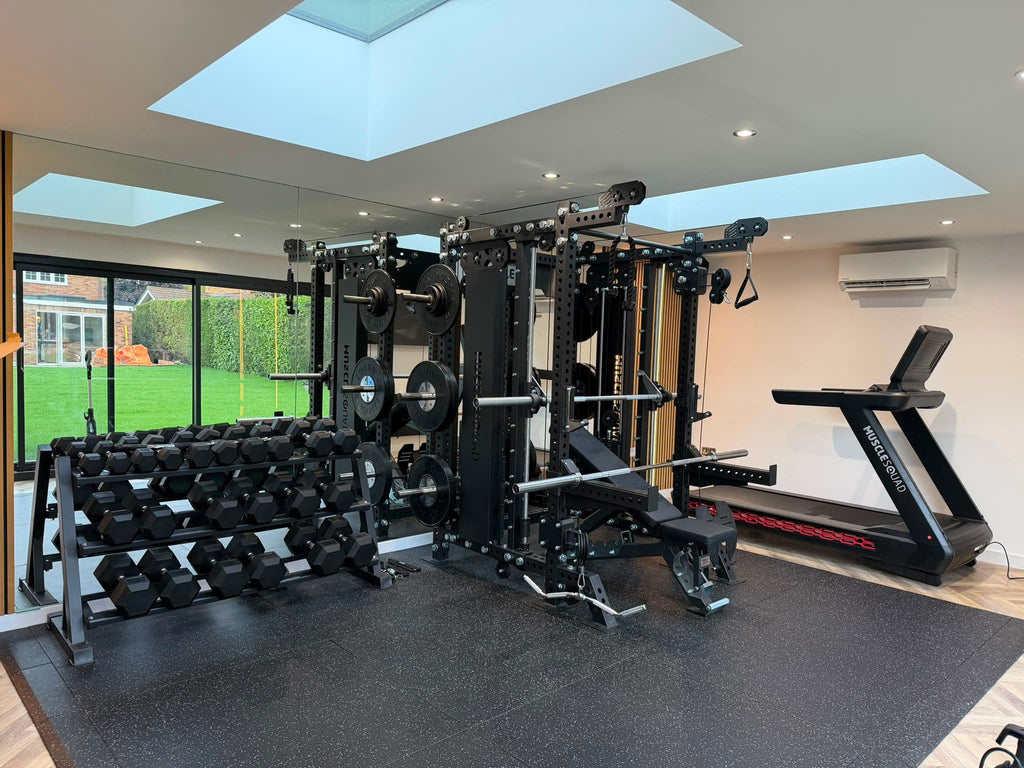
In the home market, all-in-one systems dominate the conversation. These sit in the footprint of a power rack, with a cable machine (and sometimes a Smith machine too) built into the same frame. You get three machines for the space and price of one.

These are comfortably our bestsellers at MuscleSquad since they have all of the features of a standard functional trainer, with the added benefit of supporting your barbell and Smith machine lifts, too. These are the best choice when building a home gym, and the toughest machines like our Phase 4 system are even suitable for PT studios and commercial facilities.
The specs that matter
Those are the main types of cable machines you'll come across while shopping, each with a clear use case. Whichever frame you go for, there's a second layer of choices that'll shape how it actually feels to train on. Here's what to look out for.
Plate-loaded or pin-loaded?
The first thing to consider is whether you want your cable machine's weight source to be a set of 2″ plates, like your barbell takes, or a more standard pin-selected weight stack like you'd see in commercial gyms.
Plate-loaded machines are usually cheaper, though you will need to buy a set of plates to use with them. A 100kg rubber bumper set is typically between £300-£350, so factor that into your budget when considering one.
The obvious benefit of these is that you already need weight plates if you're training with a barbell. By using them with your cable machine too, you keep the costs down.

The other choice is a pin-loaded cable machine. These come with a dedicated weight stack that can be adjusted by inserting a pin into a different part of the stack. They're much quicker to change between weights, making it possible to train supersets and dropsets on them.

On top of that, you get more choice in cable ratio with a pin-loaded machine. Many of these machines come with a 2:1 cable ratio, with 1:1 and even 4:1 options out there based on your needs. They're more convenient, smoother to train with but come at a higher price point as a result.
1:1 or 2:1 cable ratio?
We've already mentioned cable ratios a few times, so let's define what that means.
Cable ratio refers to how your cable machine's pulley system is set up, and how that changes the weight you feel when training on the machine.
A 1:1 cable ratio means that 20kg of resistance on the weight stack would provide 20kg of resistance when you pull on the handle. A 2:1 cable ratio would generate half that resistance, so 10kg, from the same 20kg of weight.

It sounds counter-intuitive to reduce the weight you have available to you, but there are actually a lot of benefits to 2:1 machines. We've written a separate piece on cable ratios that goes more in-depth, but where possible our preference is to have both a 1:1 and 2:1 ratio on the same machine.
If you do have to choose, then go 1:1 for heavy lifting and 2:1 for all-round performance.
Single or dual stacks?
If you decide to go for a pin-loaded cable machine, you'll notice that some racks come with a single weight stack and others come with two. Unless you're limited by space, then two stacks is nearly always the way to go.
Besides enabling cable flys, they improve the efficiency of your workouts. Rather than constantly needing to change the attachment handle over, you can effortlessly move from a D-handle on one side of the machine to a straight bar on the other without losing momentum. That's the sort of quality-of-life feature that you'd miss once you no longer had it.
Fixed or adjustable pulleys?
Most cable machines come with adjustable pulleys that you position up and down the uprights. This is great; there's no downside to it.
You can also get fixed pulleys, where it's not possible to change the position. These aren't as preferable, but there's usually a reason the manufacturer has chosen to use a fixed pulley. For instance, we use a dual setup on a lot of our all-in-one racks where we have a fixed 1:1 pulley at the very top of the front upright, as well as an adjustable 2:1 pulley that runs along the frame. This is the most space-efficient way of combining both ratios in one machine and is a trend that's becoming more common in the market.

Fixed pulleys are also used in high-and-low systems, where you have a single access point at the top and bottom of the rack. This covers most of what you'd want to perform on a cable machine, but if it's the only cable system on your rack then you should consider whether you'll miss rear delt flys, ab rotations and any other movements that you do by setting a cable around the middle of the uprights.
Now that we've covered what sets different cable machines apart, why not take a look through our catalogue. We're confident there'll be one listed that suits what you're after.
(Plate-Loaded)
Why should I get one?
Cable machines are one of the most versatile purchases you can make for your gym. We absolutely recommend adding one to your lineup if you haven't already. Here's why.
Exercise variety
With the right set of attachments, you can train every single muscle group on a cable machine. You could perform a full body workout on a standard functional trainer if you wanted to.
Bars can be used for rowing and curls, ropes for pullovers and pushdowns, handles for presses and cuffs for shoulder raises and leg extensions. Few pieces of equipment provide that much variety without needing to change station once.
Cable-only movements
A major selling point for cable machines is the exercises that can only be performed on them. The lat pulldown is the obvious one. If this exercise is a non-negotiable for your gym space, then the decision is already made: you need a cable machine. The list of iconic cable exercises goes on. It's hard to imagine a push session without some tricep pushdowns, and cable rows are a reliable workhorse on pull days, with the target muscle easily changed by swapping the attachment.

It's easy to see why a combination of cable and free weight movements is recommended by nearly every serious lifter.
Constant tension
Cable machines produce constant tension when you're training, which some fitness professionals swear by when it comes to really activating the target muscle. What this means is that, since you're pulling a weight stack through a cable, there's equal resistance throughout the whole movement. It takes as much resistance to lift the weight stack up that first 5% of a movement as it does the final 5%.
This isn't the case with free weights like barbells or dumbbells, where the resistance varies based on where in the movement you are. A shoulder lateral raise is a good example. They probably feel relatively easy as you start bringing a dumbbell up to your side, but get increasingly harder the higher you go. This can create a fallacy, especially in less experienced lifters, who might stop when the movement begins to get tough, not knowing that's where the progress happens and that they're simply trying to lift too heavy.
In a cable lateral raise, there's equal tension throughout the lift. This leads to more time under tension, which is an important part of building strength and muscle.
Rehabbing injuries
Since cable machines don't rely on your stabiliser muscles so much, they're gentler on your joints than free weights. This all comes from how you pull the cable along a fixed path. Your body doesn't need to stabilise the weight and keep it balanced, which eases pressure on your joints.
As such, they're the go-to for treating injuries and rehabbing muscles after time away from the gym. In fact, I (the blog's author) still do some rotator cuff exercises on a cable machine before every single upper body session to warm my joints up, so even if I'm not actually training on a cable machine that day I still use one religiously.
What to consider before buying
Measure your space
This is first for a reason. Your cable machine, whether it's a standalone tower or all-in-one rack, is almost certainly the tallest piece of equipment in your gym. So measure your ceiling height first. The difference between 2.2m and 2.5m is a significant one when it comes to gym equipment.
Of course, it's one thing to fit the machine into your room and another to use it. If your cable machine has a pull-up bar attached to the frame, then we'd recommend another 30cm of clearance above the top upright so you don't bash your head when training. If you're planning to do muscle-ups then you'll need considerably more clearance, but no doubt you're already aware of that.
You should also allow one metre of space in front of the rack so you can comfortably perform all cable exercises.
Choose the right ratio
Where possible, we strongly recommend choosing a rack that has dual cable ratios. If budget or space is preventing you from getting a dual ratio machine, then the choice is this:
Best for heavy lifting, especially rows and lat pulldowns.
Best for overall performance, with lighter jumps between weights.
Look at it this way if you're struggling to decide: would you rather have a dumbbell set that goes up to 50kg in 5kg increments, or a 30kg set that progresses in 2.5kg increments?
Invest in attachments
Having a full suite of cable attachments to choose from will improve your cable experience tenfold. You'll probably find yourself using birthdays and Christmases to add funky new attachments to your collection, but let's cover the fundamentals for now.
Your shopping list:
- 2 x D-Handles
- Tricep rope
- EZ curl bar
- Ankle strap
- Wide bar

Check if your rack comes with any of these. If not, we strongly suggest adding them.
What should a beginner buy?
It can be daunting to shop for a cable machine as a beginner, but don't be put off by the heavy weight stacks. They exist to futureproof your rack and support heavier lifts. As long as you have a stack that's on a 2:1 ratio, you'll be able to progress through the lighter increments no problem.
In terms of practical advice, we'd recommend a dual stack functional trainer for beginners. They're versatile, budget friendly and will cover you through all of the fundamental cable lifts.
Our Dual Action Pulley machine is a great choice in this category. It does everything you need reliably and without any fluff.
What exercises can I do on a cable machine?
A lot. So many, in fact, that we've put together a separate page with all of the exercises you can do on a cable machine. Here's a sample of what's possible, though, along with the attachment we'd recommend for it.
Back
- Lat pulldowns
- Cable rows
Shoulders
- Lateral raises
- Front raises
Biceps
- EZ bar curls
- Rope hammer curls
Triceps
- Tricep pushdowns
- Overhead extensions
Chest
- Cable flys
- Chest press
Lower body
- Glute kickbacks
- Leg extensions
- Hamstring curls
Core
- Ab rotations
- Weighted cable crunches
How do I maintain my cable machine?
Cable machines have more moving parts than most pieces of gym equipment, which means a bit more upkeep to keep them running smoothly. We've covered this in full in our cable machine maintenance guide, but the short version:
- Stretch cables out overnight to straighten them
- Add a small amount of silicone oil to the guide rods to keep the weight moving smoothly
- Adjust cable tension if you aren't satisfied with its setup

Leave a comment: