

 Oct 13, 2026 - Cameron Brierley
Deadlifts are one of the best exercises for building full-body strength. They're a staple of strength and conditioning for professional athletes and one of the 'big three' lifts in powerlifting, alongside the squat and bench press.
There's more than one way to deadlift, though. From single-leg variations to different bars, it's a movement that's as versatile as it is popular.
We've compared two of the most common variations: the standard barbell deadlift and the trap bar deadlift. It's a question we often get from customers kitting out a home gym, so we asked Carl Jeffers, MuscleSquad's brand manager and a qualified personal trainer, for his take.
The short answer
The barbell deadlift is the better all-round strength builder and works your lower back, glutes and hamstrings harder. The trap bar deadlift puts less load on your lower back, works your quads more and is easier to learn. That makes it the better pick for beginners and anyone who wants to go easy on their back.
Key terms
First things first, let's get some definitions out of the way.
Deadlift: the standard (conventional) deadlift. You stand over the barbell, hinge at the hips with a straight back, grip the bar and stand up until you're upright.
Barbell: a standard 7ft Olympic barbell.
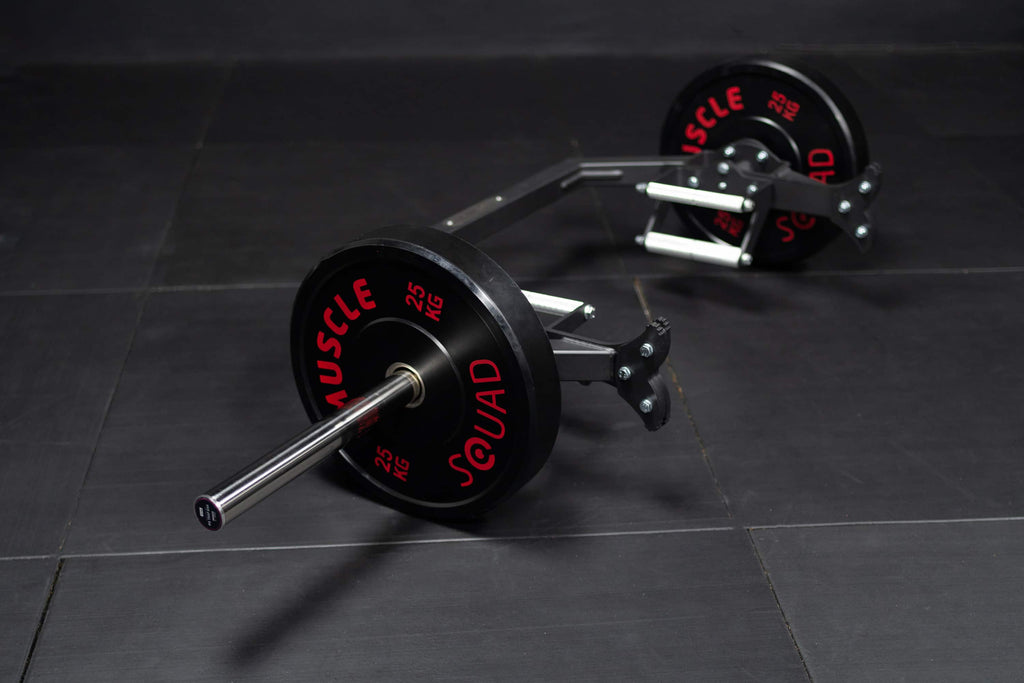
Trap bar (or hex bar): a speciality bar with a hexagonal shape. You stand inside it and hold the handles at your sides, so the weight sits in line with your body rather than in front of you.
So why use different bars in the first place? It comes down to where the weight sits and how that changes the movement.
Barbell vs trap bar deadlifts
1.Barbell deadlifts
Best for: full-body strength
Muscles worked: lower back, glutes, hamstrings, upper back, forearms, core
The barbell deadlift is a true full-body movement. It takes a strong lower body, grip strength and a stable core to do well.
Because the bar sits in front of you, it's a hip hinge. That puts a lot of the work on your lower back, glutes and hamstrings, building strength in an area that's often overlooked.

That load on your lower back is also where the risk comes from. The barbell deadlift suits intermediate lifters who are confident hingeing with a straight back, since poor form can lead to serious lower back injuries.
2.Trap bar deadlifts
Best for: quad strength and taking strain off your lower back
Muscles worked: quads, glutes, hamstrings, upper back and traps, forearms
With a trap bar, the weight sits on either side of you rather than in front. Your hands are by your sides too, which most people find more comfortable than reaching down in front of a barbell.
This changes the exercise significantly. The movement pattern becomes part hinge, part squat. You get more quad work than a barbell deadlift, with far less strain on your lower back and less hamstring and glute activation. That said, it's still a deadlift so is absolutely a compound lift that works your whole body.

Because there's less hingeing, the trap bar is generally easier for beginners. Most people find that they can lift more weight on a trap bar too.
Carl's tip
Carl prefers using a trap bar in his own workouts, and adds a few weight plates under his heels to shift even more of the work onto his quads.
Barbell vs trap bar deadlift at a glance
Choosing between them
Should you do both?
You don't need to do both in the same workout. There's a lot of overlap between them, so it's better to pair one with a different hinge exercise.
One approach is to perform trap bar deadlifts for the lower body emphasis, and then add in a different type of hinge movement like a Romanian deadlift (RDL) or hyperextension to cover all your bases.
Which is better: barbell or trap bar deadlifts?
Neither is better. It all depends on your goals, your experience and how comfortable you are adding heavy loads to your lower back.
Choose the barbell deadlift if:
- you want the best all-round builder for full-body strength
- you're confident hingeing with a straight back
Choose the trap bar deadlift if:
- you're new to deadlifting
- you want to build quad strength
- you want to limit the load on your lower back
Barbell vs trap bar deadlift FAQs
Is a trap bar deadlift easier than a barbell deadlift?
For most people, yes. The weight sits in line with your body and there's less hingeing, so it's easier to keep good form and puts less load on your lower back.
Can you lift more with a trap bar?
Most people can. The weight sits closer to your centre of gravity and your quads do more of the work, so you can usually handle a heavier load than on a barbell.
Is a trap bar deadlift better for your back?
It puts less strain on your lower back than a barbell deadlift, which is why it's often recommended for beginners. That's not an excuse for overlooking the form, though. It's still a deadlift so you should make sure you're confident lifting the bar only before adding plates to it.
Is a trap bar the same as a hex bar?
Yes. Hex bar is another name for a trap bar, given for its hexagonal shape.
Can you replace barbell deadlifts with trap bar deadlifts?
Yes, and many people do to reduce lower back strain. If you drop barbell deadlifts, add a lighter hinge exercise like a Romanian deadlift or hyperextension to keep your hamstrings and lower back strong.

Leave a comment: