

 Sep 09, 2026 - Cameron Brierley
There are a lot of questions that come up when you mention smith machines: how do they compare to traditional barbell training, are they safer, are there any disadvantages?
These can distract someone from the main takeaway that we have about smith machines after manufacturing gym equipment for almost a decade: they're not a replacement for a barbell. They're a different piece of equipment entirely with a separate list of pros and cons.
Here's everything you need to know about smith machines before you invest in one yourself.
Why train on a smith machine?
There are plenty of reasons to choose a smith machine. It makes training alone simpler and safer, helps you put all of your strength into a movement and offers a more controlled way to rehab injuries. Here's a closer look at what makes one worth the investment.
What is a smith machine?
A smith machine is made up of a straight bar fixed along two steel rails that can be latched along the frame with a simple twist of your hands.
It looks and functions a lot like a traditional barbell, which is where the comparisons come from, but a smith machine can only be lifted up and down along its rails. This is why smith machine training is often referred to as working in a fixed path.
Safety catches are placed along the smith machine's frame, meaning the bar can be twisted at any point in a lift to latch onto the nearest spot on the frame. This is what makes them so popular for solo training, since a person is able to bail out of a lift even if they can't bring the bar all the way back up to the starting position.
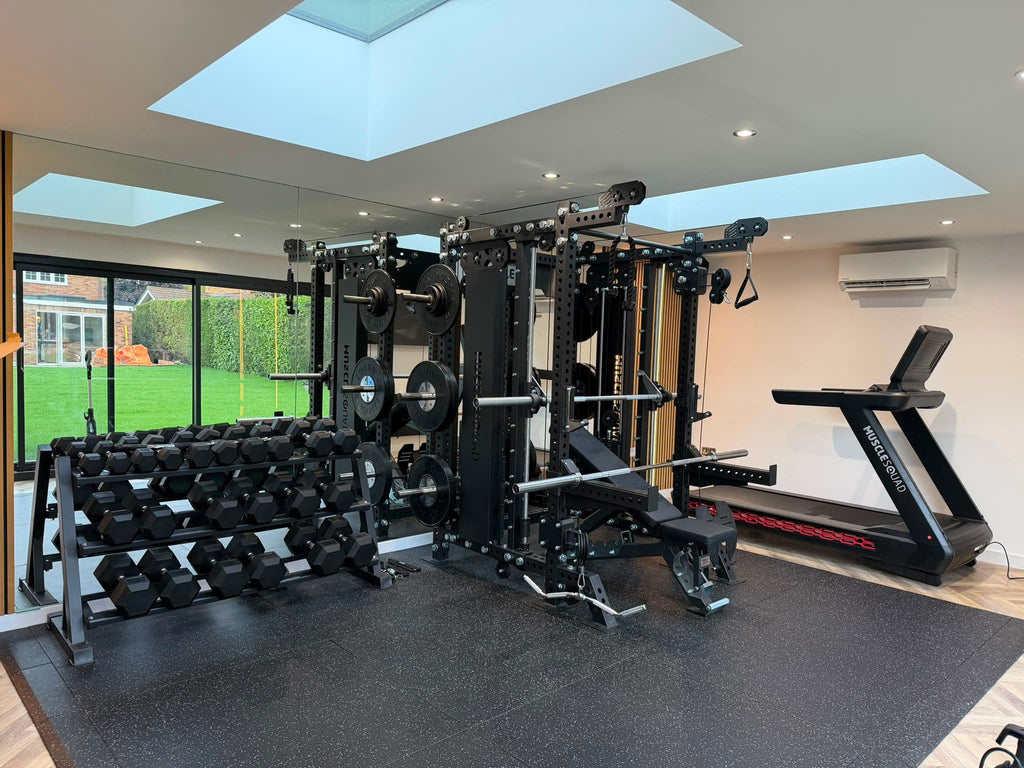
Smith machines come as standalone units or built into all-in-one systems.

Smith machine vs barbell
The key difference between a smith machine and a barbell is how the bar travels. A barbell can go in any direction that you can lift it, whether that's forward, back or side-to-side.
A smith machine operates on a fixed path, which means the bar can only travel up and down the rails.
There are pros and cons to both systems. Barbell training, where you have to balance the weight as you lift it, recruits more stabiliser muscles. Think about a barbell bench press for example: when you're pushing the weight up, you're also having to ensure that the bar maintains a consistent path.
Smith machines reduce the demand on your stabiliser muscles. Some people find this isolates the target muscle more effectively, but it's worth noting that your stabiliser muscles have real-life uses in sports and daily tasks, so neglecting them completely isn't advised either.
A smith machine isn't better or worse than a barbell. Like most things in life, the key is balance. There are times when a smith machine is more suitable for an exercise and there are times when a traditional barbell setup excels. We'll give you some examples later on in the piece.
Are smith machines safer than barbells?
It's a common opinion that smith machines are safer than barbells. And while we agree on the whole, there is some nuance that gets missed.
Since smith bars can be latched into place at any point on the frame, they eliminate the need for a spotter to help you out of failed lifts.
But, we do think that people often forget that spotter arms exist on standard squat racks for this very reason. Our all-in-one systems come with spotter arms and J-hooks as standard. The idea is that, before a heavy squat or bench press, you set the spotter arms up at the correct height to catch a failed lift if you can't complete a rep.
When you properly use spotter arms, then the safety difference is negligible between a smith machine and barbell.
Injury prevention and rehab
Smith machines are often recommended for exercise rehab, especially when someone is returning to lifting after something like a shoulder injury.
This is because the fixed plane of motion that defines a smith machine makes it ideal for reducing the strain on your joints. Your body only needs to focus on moving the weight up or down, not on stabilising it throughout the lift, which can be a gentler way to ease yourself back into training after time away from injury.
It's also a useful stepping stone for anyone who's less experienced with weight training and doesn't have the stabiliser strength yet to work with a standard barbell.
Counterbalanced smith bars
Ever noticed how the smith machine in one gym seems to weigh a ton, while the smith machine in another gym feels easy to lift? This is all to do with counterbalancing, and it's quite common in smith machines.
Counterbalancing works by attaching a weight to the bar that offsets part of its resistance. This helps the bar glide more smoothly and leads to a lower base resistance, which is why counterbalanced smith machines feel so much lighter than their counterparts.
If your machine is counterbalanced, the manufacturer will be able to tell you what the base resistance is. For example, our Multi-Functional Trainer uses counterbalances for a starting resistance of 7kg.
In fact, counterbalancing is the reason why it's so hard to tell you how much a standard smith bar weighs, but we've answered it as best we can on this page.
Plate compatibility
The vast majority of smith machines, including ours, are compatible with 2-inch Olympic weight plates, the same as a standard barbell.
If you already have a set of weight plates that fit your barbell, then you can use these on a standard smith machine without needing to invest in more.

Bearings vs bushings
The rails that your smith bar runs on use either bearings or bushings to keep the movement smooth.
Bearings are usually the better option. They sit against the rails and contain small metal balls that reduce friction as the bar is travelling. They tend to run smoother and don't wear down as easily as bushings.
Bushings are the cheaper alternative, where a simple sleeve sits in contact with the rail, making it more susceptible to friction and showing signs of wear over time, especially in high-traffic environments like a commercial gym.
Most of our smith machines use bearings for this reason.

Bar path: straight vs angled
Most smith machines run in a completely vertical line, but there are some exceptions to this rule that run on an angled path. These are typically standalone commercial units.
The idea is to add a more natural movement path to the fixed-plane setting of a smith machine. Some users prefer the angled setup, especially in movements like squats and deadlifts where it mirrors the way your body moves more accurately.
That said, the drawback is that not all smith exercises are suited to an angled system, so it sacrifices some versatility in favour of a few key exercises.
All of our smith machines use a straight path. It's a simpler system that keeps the movement pattern predictable and enables a broader range of exercises.
When should I use a smith machine?
Smith machines have their place in your program just as barbell work does. Which exercises you use one for comes down to your goals.
Incline bench press is one of the most common exercises that people perform on a smith machine. Doing this exercise with a barbell would mean reaching up and behind you at an awkward angle to unrack the bar. This can cause a lot of strain to your shoulders that a smith machine, in its fixed movement plane, avoids completely. The same is true for seated shoulder presses.
For everything else, the best thing to do is try each exercise on both stations and see which feels more natural to you. If you need to prioritise isolation, then you should probably use a smith machine. If you're performing compound lifts and looking to build overall strength, then you're likely looking at a barbell exercise.
What exercises can I do on a smith machine?
You can do just about everything on a smith machine that you'd do with a barbell: squats, bench press, overhead press, rows, lunges, deadlifts and more.
The fixed bar path also opens the door to a few exercises that aren't suited to barbell training. Calf raises are a good example, since the bar can be loaded heavy and doesn't require you to maintain your balance while performing the movement.
Leg press is another, provided you've got an attachment that slots over the smith bar. This is a popular home gym hack where users lie on a bench underneath the smith machine and push upwards against the metal plate.
To give you some ideas to get started with, we've built a list of 21 exercises to try on a smith machine.
Rounding out your setup
A smith machine rarely sits on its own. Pair it with a weight bench for pressing work, and make sure you have enough plates to cover everything you're planning to train.
Our smith machines come included with a lot of our all-in-one systems, which have quickly become the standard choice for people building a home gym. They're by far the best solution for space, value and the range of exercises they enable, and now you know how a smith machine fits into that equation.

Leave a comment: